The short answer
Tactical marketing is the set of specific, short-term actions that produce results now, such as an ad campaign, an email, or a blog post. Strategic marketing is the long-term plan that decides who you serve, what you promise, and which tactics deserve budget. Strategy picks the direction; tactics are how you travel it.
A quick test separates the two. Ask whether the work has an end date and a number attached. A campaign that runs for six weeks and is judged on booked calls is tactical. A decision about which customers to pursue for the next year, and why, is strategic.

What tactical marketing looks like in practice
Take a Google Ads campaign for one service. It has an audience, such as homeowners searching for a specific repair, a monthly budget, a landing page, and a target cost per lead. After a few weeks you can see whether it worked, and you can change it or stop it. That is the shape of every tactic: it is specific and it ends.
Emails and blog posts fit the same pattern. Each is something you can finish and measure.
What strategic marketing decides
Strategy covers the questions that sit above any single campaign. Who is the ideal customer, and what problem sends them looking? Why would they pick you over the alternatives? Where will you spend a limited budget, and what will you leave out? Strategy also names the few numbers that show whether the plan is working.
It is deliberately stable. You revisit it quarterly or yearly, because changing it weekly would turn it into a list of tactics.
How the two jobs differ day to day
Strategy runs on a long feedback loop. A positioning decision may take months before the sales numbers show whether it was right. Tactics run on a short one, and a bad ad shows up within days. That difference shapes how each fails. Strategy can turn into endless planning with nothing launched, while tactics can turn into polishing something that should not exist.
The relationship runs one way. Strategy sets the target, and tactics are how you hit it. A tactic that cannot be traced to a strategic goal is a candidate to cut.

Who does each job
Strategic marketers hold titles such as marketing director or fractional CMO. They spend their time on positioning and budget, and they need to read a profit and loss statement as comfortably as a creative brief.
Tactical marketers are the specialists who build and tune the work, such as a paid media buyer who manages a Google Ads account day to day. Their value is knowing one platform well enough to spot what a number means.
In a small business one person often does both. That works until the workload grows, and when it does, the planning is usually what slips, since the campaign due this week feels more urgent than the plan for next quarter.
One strategy, several tactics
Consider a local service company that decides to win larger commercial accounts instead of one-off jobs. That decision is the strategy, and it rules some things out, such as discount offers aimed at homeowners.
The tactics follow from it. The company might publish case-study pages, write to facility managers directly, and change its quote form to ask for project size. None of these is clever alone. Each works because it serves the decision above it.
What happens when one is missing
Without strategy, the symptoms are easy to spot. The business changes platforms every few months, judges results by whatever number is highest, and cannot say why a campaign was launched. Without tactics, the symptom is a strong plan that sits in a document while the market moves.
The fix in both cases is the same: connect every active campaign to a written goal, and connect every goal to an action someone owns.
Building a tactical marketing plan
A tactical plan turns one strategic goal into dated actions, and it should fit on a page.
- Start from one goal, such as more consultation requests for one service this quarter.
- Name the audience and what they are trying to do when they see the campaign.
- Choose the one or two places where that audience already looks, and resist adding more.
- Write each action as a task with an owner and a date.
- Pick the number each action should move. The guide to marketing KPIs helps you choose.
- Set a review date and decide in advance what would make you stop or change course.
Building a strategic marketing plan
A strategic plan is slower to write because it forces choices. Begin with the customer: who buys and what triggers the search. Then write the reason they should pick you in plain words, and check that you can back it with proof you can show. From there set a revenue or customer goal for the year and split it by quarter. Then decide where the budget goes and what you will not do. The growth marketing guide shows how that plan then runs as a loop of testing and learning.
Which one to invest in first
For an owner-led business with a small team and no written plan, start with strategy, kept short. Without it, tactics get changed every month, because nobody can say what a good result is. A few pages that fix the customer and the goal are usually enough to give the first campaigns a direction.
The exception is a business that already has a clear plan but lacks the people to carry it out. There the money belongs in execution, whether that is one specialist or an agency.
On cost, a strategy engagement is typically a bounded piece of work, while execution is an ongoing cost that includes people and media budget. Strategy can look like the cheaper option, and doing it first often prevents spending that execution budget on work that goes nowhere. Exact figures vary too much by provider to quote here.
What to do next
If you have no written strategy, spend the next two weeks on the one-page version: the customer, the promise, a goal with a number, and a budget. If you already have one, choose the single tactic that serves the goal most directly and give it an owner and a date.
Strategy and execution from WGM
The usual ways to get both are to hire a marketing director or to use an agency that runs campaigns. A full-time director brings one person's skills and a salary with benefits, and the hire can take months. An agency that only runs ads can leave you without anyone who owns the overall plan.
WGM works differently. Through Growth Partner, a fractional CMO owns the strategy part time and a team carries out the work, so one plan and one report cover both. If you have no written strategy yet, the Growth Sprint produces one on its own, before you commit to ongoing execution.
Frequently Asked Questions
Is social media a tactic or a strategy?
Social media is usually a tactic. The strategy is the decision about which customers you want to reach and whether social media is the right place to find them. Posting without that decision tends to produce activity with no clear aim.
Which metrics belong to strategy and which to tactics?
Strategic measures track the business: revenue, cost to win a customer and how many customers return. Tactical measures track one campaign, such as clicks, cost per lead or email open rate. Tactical numbers should roll up to the strategic ones.
How many tactics should a small business run at once?
As few as the team can run well and measure. For many small businesses that is one or two active campaigns plus ongoing basics such as a maintained website. Add another only after you can read the results of the first.
What is the difference between a marketing strategy and a marketing plan?
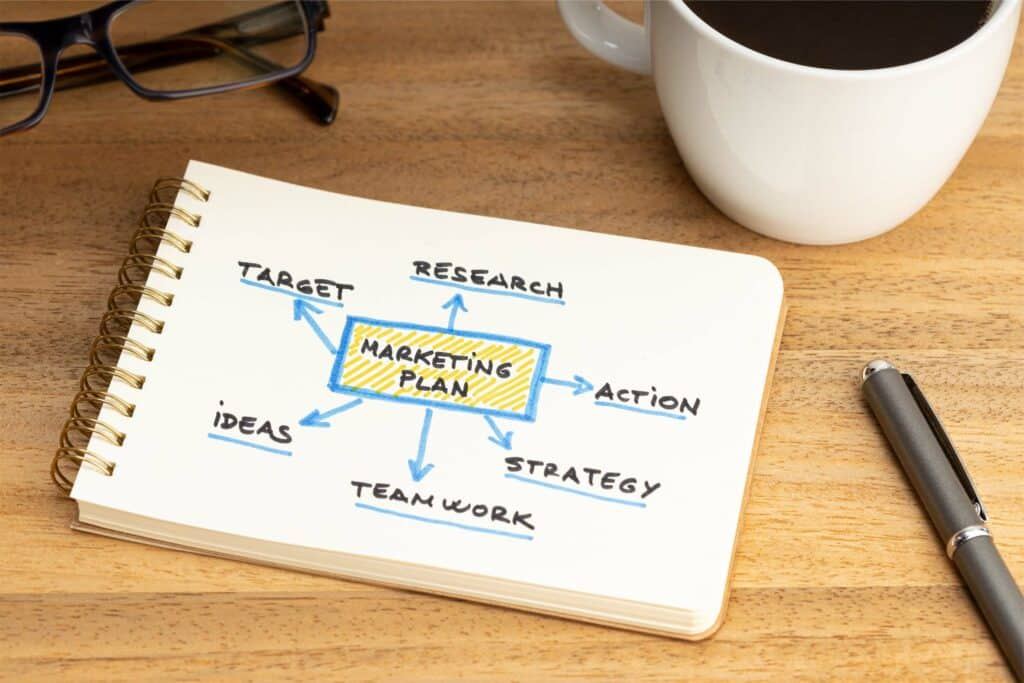
The strategy sets the direction: customer, positioning and goals. The plan lists the actions, owners, dates and budget that carry it out. A strategy can exist without a plan, but a plan without a strategy has nothing to aim at.